Acacia Estates is DMCI Homes’ roughly 150-hectare low-density township in Taguig, where 60% of the land is permanently kept as open space. A ₱4.5-billion upscaling initiative targets 2028, alongside a planned subway station one stop from BGC and one from NAIA. Alder Residences (ready now) and Mulberry Place (pre-selling) are the two ways in. The pre-selling address inside the township is Mulberry Place — prices, unit layouts and availability.
Most people evaluate a condo one building at a time. Smart investors are starting to evaluate the township around it instead — and right now, no township in Metro Manila is generating more quiet buzz than Acacia Estates in Taguig. A ₱4.5-billion master plan is underway, a subway station is on the horizon, and two very different DMCI properties are sitting right at the center of it. Here's the full story.
What Is Acacia Estates?
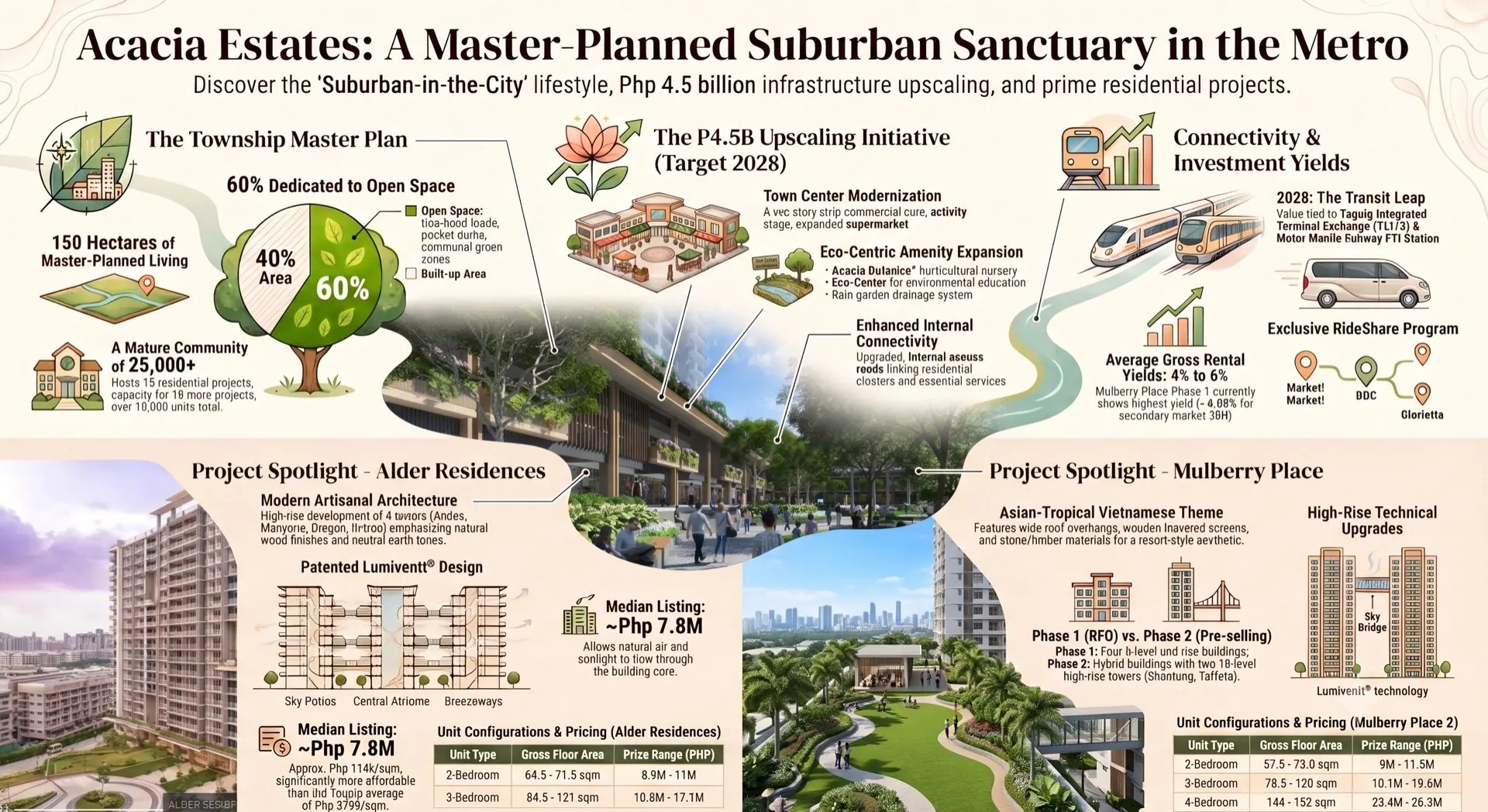
Acacia Estates is DMCI Homes' flagship low-density township in Taguig — a self-contained "suburban-in-the-city" community spread across roughly 150 hectares, with 60% of the land permanently dedicated to open space: tree-lined roads, pocket parks, and communal green zones. Only 40% is built up. That single ratio is the whole investment thesis in one number — while the CBDs next door keep getting denser, Acacia Estates is structurally committed to staying green and walkable.
It's already a mature, functioning community, not a concept on paper: 25,000+ residents across 15 residential projects, more than 10,000 units total, with capacity confirmed for 10 more projects to come.
Straight From DMCI: The Redevelopment Announcement
This isn't just a marketing narrative on our end — DMCI Homes made it official. In their own release, DMCI Homes Unveils Redevelopment Concepts for Acacia Estates Township in Taguig, the developer laid out its vision for the estate: new access roads, revitalized commercial strips and plazas, additional nature parks, and a fully revitalized Acacia Town Center with expanded retail and recreational offerings.
The line that stuck with us most from that announcement was the vision statement itself — DMCI's own words describe the goal as building "a bustling community where residents have access to essential services and interconnected parks, all within a walk's reach." That's not generic developer-speak; it's a specific, walkability-first design philosophy, and it's the same philosophy driving the current phase of upgrades.
DMCI Homes is the Philippines' first Quadruple A-rated real estate developer, with 60+ completed and ongoing communities since 1999 across Mega Manila, Baguio, Boracay, and Davao. Acacia Estates isn't a side project — it's one of their flagship master-planned townships.
The ₱4.5-Billion Upscaling Initiative (Target 2028)
Building on that public announcement, DMCI's current internal marketing materials for Acacia Estates put a number on the vision: a ₱4.5-billion Upscaling Initiative targeting completion by 2028. Three workstreams are driving it:
- Town Center Modernization — a revamped, multi-story commercial strip with an expanded supermarket and an activity stage for community events
- Eco-Centric Amenity Expansion — the Acacia Botanique horticultural nursery, an Eco-Center built for environmental education, and a rain-garden drainage system
- Enhanced Internal Connectivity — upgraded internal access roads linking every residential cluster directly to essential services
Put simply: this is a developer still actively reinvesting in an estate that's already mature. That's a very different risk profile than buying into a brand-new township and hoping the amenities eventually get built.
Why a Township Beats a Standalone Tower
Buying into a self-contained township instead of one building on a busy avenue changes the entire ownership experience:
- A managed ecosystem, not just four walls — security, landscaping, retail, and community services are planned at the estate level, not left to a single condo corporation
- Proven demand from day one — 25,000+ residents already live here; you're not betting on a neighborhood to "become" desirable
- The DMCI Homes RideShare Program — a scheduled carpool service running directly to BGC and Makati, plus routes to Market! Market! and Glorietta, solving the last-mile problem most suburban addresses struggle with
- Real proximity — SM Aure is 3 minutes away, BGC is roughly 3.5–6km (about 6 minutes), Makati and St. Luke's Medical Center are about 15 minutes out, and NAIA Terminal 3 is roughly 20 minutes away
2028: The Transit Leap — One Stop from BGC, One from NAIA
Here's the detail I think matters most for anyone thinking five-to-ten years out. Acacia Estates' long-term value is directly tied to the 2028 Transit Leap — connectivity plans built around the Taguig Integrated Terminal Exchange and a nearby Metro Manila Subway connection.
The detail from my own project files: the more recent briefs point to a planned Metro Manila Subway station along Levi Mariano Avenue — just one stop from the NAIA-connected station, and one stop from a BGC-connected station. If that station lands on schedule, Acacia Estates stops being merely "close to the CBDs" and becomes directly plugged into Metro Manila's rail backbone — arguably the single biggest value lever a residential address can have.
"I always tell clients: treat pre-completion transit claims with healthy patience — but position yourself early enough to benefit if it lands on time. The buyers who got in early on BGC, Ortigas, and Rockwell before their transit lines opened are the ones sitting on the biggest gains today."
The Two Hero Properties Leading the Charge
Every township needs a flagship — Acacia Estates has two, each built for a completely different kind of buyer.
Alder Residences — Unmatched High-Rise Value
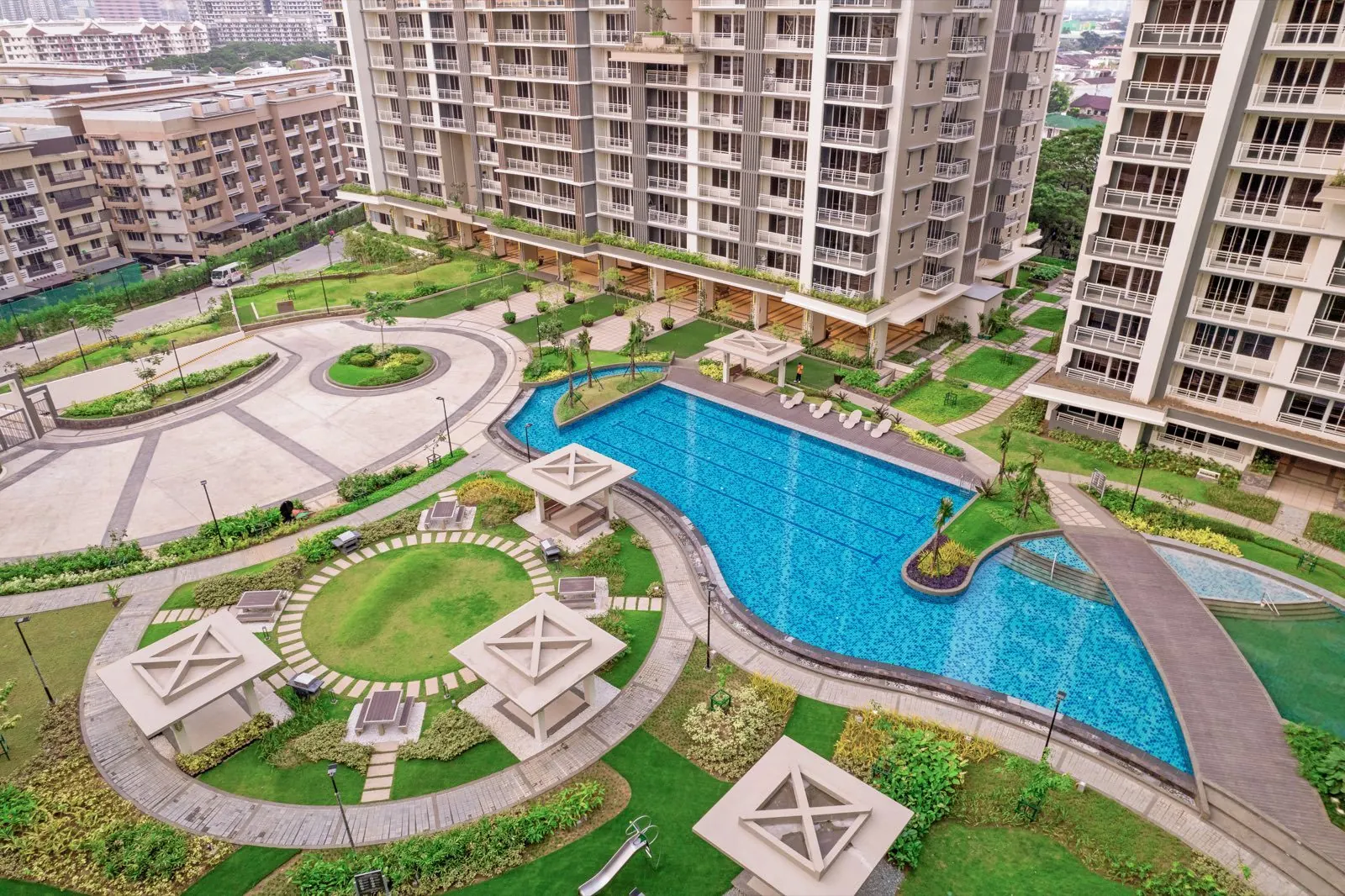
Alder Residences is the affordability play with real architectural substance. Its Modern Artisanal design leans on hand-finished stone and natural wood, built around DMCI's patented Lumiventt® Design Technology — sky patios, central atriums, and breezeways engineered to pull natural light and airflow through the building core.
The number that stops people mid-scroll: at roughly ₱114,655–114,936 per sqm, Alder runs about 58–60% more affordable than the Taguig average of ₱279,104/sqm. Half the estate's land here is dedicated to wellness amenities alone — lap pools, leisure pools, kiddie pools, a tree court, and co-working spaces. Median listing sits around ₱7.8M; 2-bedroom units start around ₱8.9M and 3-bedrooms range up to ₱17.1M.
Mulberry Place — Smart Capital Leverage
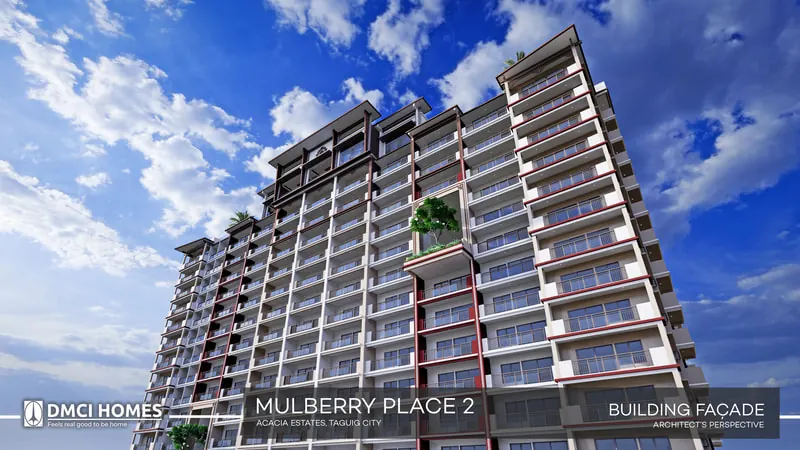
Mulberry Place is the resort-style, family-first sanctuary — an Asian-Tropical, Vietnamese-inspired low-density community of wide roof overhangs, wooden louvered screens, and stone-and-timber facades. It's 2BR, 3BR, and 4BR only — no studios — which tells you exactly who DMCI built this for: stable, owner-occupied families, not short-term flippers.
The investment story here is capital arbitrage. Mulberry's Phase 2 pre-selling units — the newer, high-rise Shantung and Taffeta towers connected by a signature sky bridge — carry a premium of over 40% compared to Phase 1. Early Phase 1 buyers already captured serious appreciation; current Phase 2 buyers are positioned to capture the next wave as those towers approach completion. Terms are flexible too — as low as 12% down spread over 38–50 months. And Mulberry Place Phase 1 already shows the receipts: it posts the estate's highest rental yield, around 6%, against a township-wide average of 4–6%.
Frequently Asked Questions
What is Acacia Estates?
Acacia Estates is a 150-hectare master-planned township by DMCI Homes in Taguig City, with 60% of the land preserved as open space and over 25,000 residents across 15 residential projects.
Is Acacia Estates a good investment in 2026?
Yes — it combines an established, mature community with an active ₱4.5-billion redevelopment plan targeting 2028, plus proximity to BGC, Makati, and a planned Metro Manila Subway connection, all of which support long-term price appreciation and strong rental demand.
What is the ₱4.5-billion Acacia Estates upscaling initiative?
It's DMCI's township-wide investment plan targeting 2028, covering Town Center modernization, an eco-centric amenity expansion (including the Acacia Botanique nursery and Eco-Center), and enhanced internal road connectivity.
Will Acacia Estates have a subway station?
Planning materials point to a future Metro Manila Subway station along Levi Mariano Avenue, one stop from a NAIA-connected station and one stop from a BGC-connected station, tied to the broader 2028 Transit Leap and Taguig Integrated Terminal Exchange. Treat this as anticipated infrastructure until officially confirmed on a public timeline.
What's the difference between Alder Residences and Mulberry Place?
Alder Residences is a high-rise, Modern Artisanal community priced roughly 58–60% below the Taguig average per sqm — the affordability and design play. Mulberry Place is a low-density, Vietnamese-inspired family sanctuary with 2BR–4BR units only, offering the estate's highest rental yield and a capital-arbitrage opportunity between its RFO Phase 1 and pre-selling Phase 2 towers.
Acacia Estates isn't a single condo bet — it's a bet on an entire, master-planned piece of Metro Manila that's still actively investing in itself, backed by a Quadruple-A developer, and sitting directly in the path of the next transit expansion. Whichever hero property fits your goals, the underlying logic is the same: buy where the township, the infrastructure, and the numbers are all moving in the same direction.
See the two hero properties for yourself
Full unit availability, floor plans, and current pricing for both Alder Residences and Mulberry Place.